Alternative
Ideawake alternative and Ideawake pricing compared side by side
An Ideawake alternative makes sense when the hard part of your idea program is no longer collecting ideas but deciding which ones to fund. Brainstormer puts the AI on the review side: it expands every submission into a full proposal, scores it against your strategic goals, merges duplicates and hands leadership a board report per challenge, with every price published and no demo call.
Why companies look for an Ideawake alternative
Ideawake is a configurable idea management platform aimed at employee, customer and partner ideas. It has the pieces a mature program expects: challenges, approval workflows, duplicate detection, gamification with points and leaderboards, dashboards, and integrations with Microsoft Teams, Slack and Jira. For a company with a dedicated innovation manager who will configure workflows and run campaigns all year, that is a serious toolkit.
Buyers start looking elsewhere for three reasons. The first is total cost. The license is only part of the bill, because Ideawake lists success and support as a separate line from $250 to $1,000 a month. The second is admin capacity. Flex, the plan with unlimited users, includes one administrator, one workflow and 25 automations a month, so a program with several reviewers outgrows it quickly. The third is the review backlog. A popular challenge can bring in a few hundred ideas, and points and leaderboards push that number up. Somebody still has to read, deduplicate, compare and decide, and that is where programs stall.

| The job | Ideawake | Brainstormer |
|---|---|---|
| Published license price | Flex $500 a month (unlimited users, 1 admin), Business $300 to $2,250 a month (50 to 2,500 users), Enterprise by quote | Team $149, Business $399, Enterprise $999 a month billed yearly |
| Support and success | Separate tiers at $250, $500 or $1,000 a month | Email support included, priority email on Enterprise |
| Buying process | Schedule a 30 minute demo | Self serve, card payment, no call |
| Where employees submit | Web, phone, Microsoft Teams, Slack | In the browser on desktop or phone, invited by email |
| AI on the idea | AI helps employees build out a business case | AI expands each idea into problem, solution, first step and success measure |
| Scoring | Configurable workflows and approval stages | AI scores impact, cost, risk and strategic fit against your goals, with a written rationale |
| Duplicates | Automated duplicate detection | AI merges duplicates, keeps every author and vote |
| Report for leadership | Dashboards and KPI tracking | Board report per challenge (Business and Enterprise), print to PDF, Markdown, CSV |
| Gamification | Points and leaderboards | Votes only, no points |
| Anonymous ideas | Anonymous posting available | No, every idea is tied to the member who submitted it |
| Single sign on, API, Jira | SSO and API mentioned, Jira integration | Not offered |
What Brainstormer does differently
Brainstormer is built around the decision, not the campaign. You describe the company, set 3 to 6 strategic goals and open a challenge such as "Where do we lose the most margin between quote and invoice?" Employees submit a sentence or two. AI expands each idea into a problem, a proposed solution, a first step and a success measure, so reviewers compare complete proposals instead of one liners.
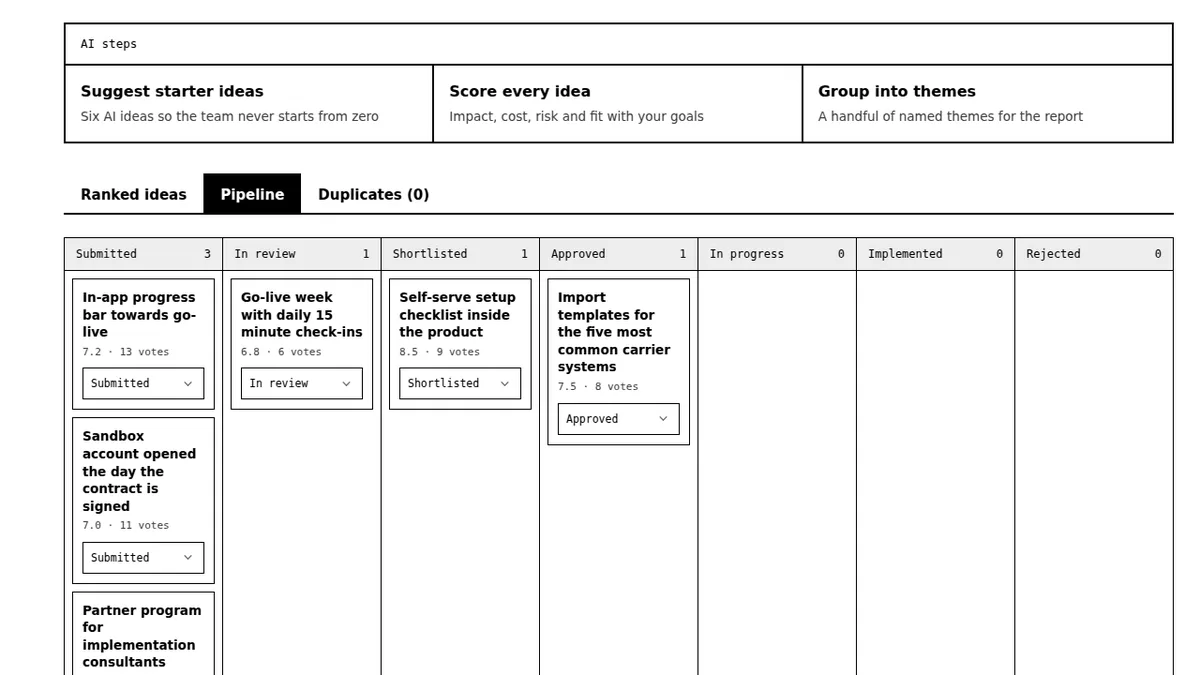
Every idea gets a score on impact, cost, risk and strategic fit against your goals, with a short written rationale your reviewers can accept or overrule. On Business and Enterprise the goals carry weights, so a company that cares twice as much about margin as about speed sees that in the ranking. Duplicates are merged with all authors and votes kept, ideas are grouped into themes, and each idea moves through seven decision stages with who, when and why recorded.
When the challenge closes, the board report lists the ranked shortlist, the themes, how many ideas reached each stage and a recommendation. That is the document an operations or HR lead takes into the leadership meeting. See it in practice as an employee suggestion program or a time boxed innovation challenge.
Ideawake pricing compared with Brainstormer
Ideawake is one of the few vendors in this category that publishes prices. Its pricing page lists three licenses. Flex is $500 a month for unlimited users, with 1 administrator, 10 groups, 1 workflow and 25 automations a month. Business runs from $300 to $2,250 a month for 50 to 2,500 users, with 5 administrators, 50 groups, 10 workflows and 500 automations a month. Enterprise is quoted, with everything unlimited. SSO, challenges and multiple communities are listed on all three. Success and support tiers are priced on top: Standard at $250, Premium at $500 and Enterprise at $1,000 a month, which differ mainly in how often you meet a success manager and whether admins get phone support. Ideawake also advertises a 90 day satisfaction guarantee.
Brainstormer prices per company, not per user. Team is $149 a month billed yearly ($1,788 a year) for up to 25 members and 3 open challenges. Business is $399 a month billed yearly ($4,788 a year) for up to 150 members with unlimited challenges, weighted goals, the board report, the admin role and the decision trail CSV. Enterprise is $999 a month billed yearly ($11,988 a year) for up to 1,000 members with full workspace export and priority email support. Month to month costs twice as much. Support is included in every plan.
Put side by side, a 50 person program on Ideawake Business starts at $300 a month for the license, or $550 with Standard support, against $399 for Brainstormer Business. A company that wants every employee in, at any headcount, gets a flat $500 on Ideawake Flex if one admin and one workflow are enough. Compare the full plans on the pricing page or read how the category prices in idea management software pricing.
When Ideawake is the better choice
Be honest about the requirement before you switch. If employees must submit ideas inside Microsoft Teams or Slack, or ideas need to flow into Jira once approved, Ideawake integrates with all three and Brainstormer does not. If your program depends on anonymous submissions, Ideawake offers anonymous posting and Brainstormer ties every idea to its author. If IT requires single sign on or an API, Ideawake lists both and Brainstormer offers neither.
Very large programs can also come out cheaper on Flex. Unlimited users for $500 a month is hard to beat for a 3,000 person company that only needs one admin and one workflow. And if you want points and leaderboards to drive participation, Ideawake has them built in. Brainstormer is the better fit when the program already gets enough ideas and the pain is turning them into decisions leadership will act on.
Switching from Ideawake to Brainstormer
Brainstormer does not import ideas from other tools, so plan the move as a clean start rather than a migration. Export what you have from Ideawake and keep it as an archive. Pick the handful of open ideas leadership still cares about and enter them as the first ideas of a new challenge, so their authors see them carried forward.
Then set your goals, write one narrow challenge question with a deadline two to three weeks out, and invite people by email. You can have the first challenge open the same week you sign up. If you are still comparing several platforms, the idea management software buyers guide lists the questions to ask every vendor, and the IdeaScale alternative, Sideways 6 alternative and Hives.co alternative pages cover three other common shortlists.
Questions
What is the best alternative to Ideawake?
It depends on why you are leaving. If you need Teams, Slack or Jira integration, SSO or anonymous ideas, look at platforms that offer them. If you need AI to expand, score and deduplicate ideas against company goals and produce a board report, Brainstormer does that with published plans from $149 a month billed yearly.
How much does Ideawake cost?
Ideawake lists Flex at $500 a month for unlimited users with one admin, Business at $300 to $2,250 a month for 50 to 2,500 users, and Enterprise by quote. Success and support tiers cost $250, $500 or $1,000 a month on top, according to its pricing page.
Does Ideawake have a free plan?
No. Ideawake sells paid licenses and books a 30 minute demo before you buy. Brainstormer also has no free plan, but you can run a demo challenge on the homepage without an account and start a trial after signup.
Is Brainstormer cheaper than Ideawake?
For most companies between 25 and 150 people, yes once support is counted: Brainstormer Business is $399 a month billed yearly with support included, against $300 or more for an Ideawake Business license plus at least $250 for Standard support. For thousands of users on one workflow, Ideawake Flex at $500 can be cheaper.
Does Brainstormer integrate with Microsoft Teams, Slack or Jira?
No. Brainstormer runs in the browser on desktop and phone, and members join by email invitation. Ideas and decisions export as CSV. If submitting inside Teams or Slack is a hard requirement, Ideawake is the better fit.
Can I move my Ideawake ideas into Brainstormer?
There is no import. Keep the Ideawake export as an archive, re-enter the few open ideas that still matter as the first ideas of a new challenge, and start fresh with goals and a deadline.
Can I try Brainstormer before buying?
Yes. Run a demo challenge with AI ideas on the homepage without an account. After signup the trial covers one challenge, three members and five AI actions.
Ask your company one question this week
Start your workspaceMore idea management tools compared
Each page lists the vendor's published pricing where it exists, what it does better than Brainstormer, and where Brainstormer fits instead.